On Tuesday, November 17, the UC Riverside School of Medicine Office of Diversity, Equity, and Inclusion hosted a lunch and learn in recognition of America’s veterans, who had been honored the week before on Veterans Day on November 11.
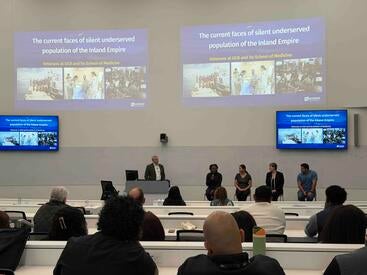
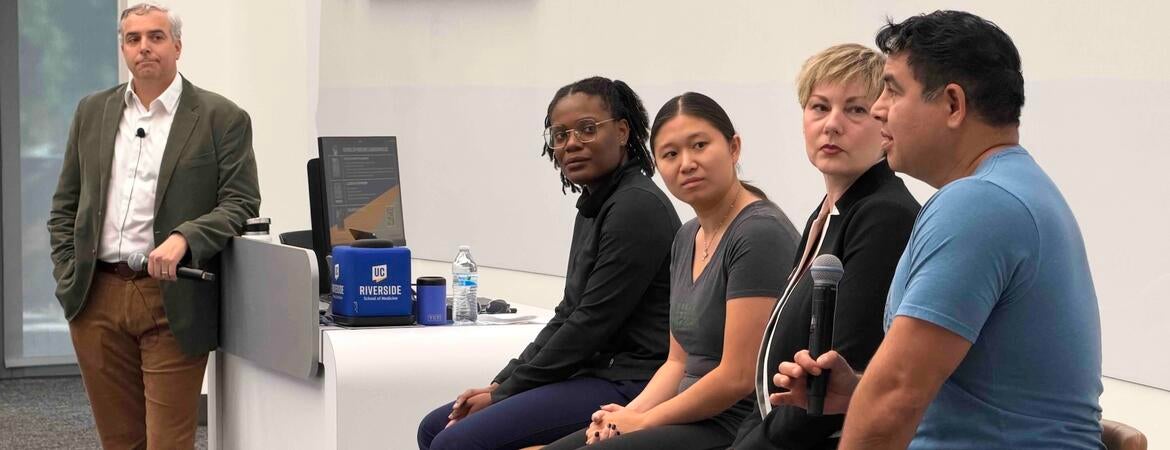
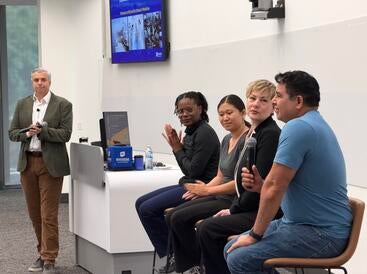
More than 60 SOM students, faculty, and staff attended the event, which featured a presentation by Scott Pegan, PhD, a U.S. Army Operation Iraqi Freedom combat veteran, U.S. Army Reserve lieutenant colonel, professor of biomedical sciences, and associate dean of pre-clerkship medical education at the UCR SOM. Following his talk, Pegan also moderated a panel of SOM student and alumni veterans, including Ackelia Ewart, a first-year medical student and U.S. Navy veteran; Emily Li, a second-year medical student and California Army National Guard combat medic; Alicia Junker, a recent graduate of the UCR SOM’s master of public health program and 23-year member of the Army Reserve; and Ulises Ponce, a second-year master’s student in biomedical sciences and a U.S. Marine Corps veteran.
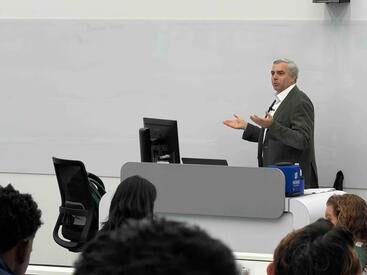
During his presentation, Pegan touched on veterans’ changing needs, barriers to accessing healthcare, and challenges veterans face in gaining a higher education and medical degree--despite the need for more veterans in the physician workforce.
Pegan drew on his own experiences, bringing a personal touch to statistics he shared. Although more than 495,000 veterans in California live with disabilities related to their service, Pegan noted that accessing care is more complicated than simply going to Veterans Affairs (VA). “It becomes a convoluted system the veteran has to navigate,” he said.
Pegan himself was initially denied disability status for an injury he sustained in Iraq until he later appealed. His presentation included graphs indicating that service members with a college degree were more likely to be able to access disability services than those without. “You shouldn't need a doctorate to figure out how to get care for an injury that you suffered in the military,” Pegan said.
Noting that a lack of cultural competency among providers remains a top barrier to veterans seeking healthcare services, Pegan emphasized the need for more veterans among the physician workforce. However, “Veterans don’t have easy access to becoming a physician,” he said. He pointed to factors including fractured academic backgrounds due to deployments and duty station moves, expired credits, advising gaps, the need to translate service records or piece together transcripts, and the challenges of those returning to school later in life with the corresponding need to support dependents, all of which can complicate veterans’ medical school applications.
The UCR SOM recognizes these issues, Pegan continued, and is working to support veteran applicants and students through mentorship efforts, exchange programs to bring more service members to campus, and more. He also noted the importance of creating spaces focused on veterans, such as the current event. “UCR is one of the top schools in veteran friendliness,” Pegan said. “We're trying to do a lot of things here at UCR that we can all be very proud of.”
The panel gave the audience the chance to have their questions answered directly by veterans at UCR. One audience member asked how those without military experience can best support veterans at the university.
“One of the biggest things is acknowledging them and embracing them as part of the community,” Ponce said, as Junker nodded. “We're going to be unconventional students--we come from different educations, we come from different backgrounds, we've had some experiences that are not very common, and so just… making them feel like they're part of the community,” he added.
Ewart asked her medical school classmates to have grace and patience. “I went off my active duty on a Friday and started school that Monday, so I'm not used to being in the school environment, but am still integrating and acclimatizing,” she said.
“I think UCR does an amazing job already, but… not every place is like that,” Li continued. “Make space so that everyone can come together and socialize and connect.” Outside of school, Junker added that voting for policies that support veterans is also essential.
The panel also answered a question focusing on experiences from the military that benefited them at the School of Medicine. Referencing her ability from the military to work effectively with anyone, “Being able to come together to collaborate is super, super important,” Junker said.
Several of the panelists mentioned the resilience they developed as service members. Time in the military “immediately set me up for all the difficulties that I have to do now, just in my first year (of medical school)… It's been a little bit hard, but I feel like I can still keep pushing for it because I've been doing it for seven years,” Ewart said.
“Every service member has that drive to succeed, and I think that's what we bring to the table,” added Ponce, who’s partway through his master’s program. “I will eventually end up in med school, I don't know where yet, but… nothing's going to stop me.”