Breast cancer is one of the most common cancers in the United States, affecting around 1 in 8 women according to the American Cancer Society. With incidence rates continuing to increase by around 1% per year, Breast Cancer Awareness Month each October promotes awareness and early detection of the disease.
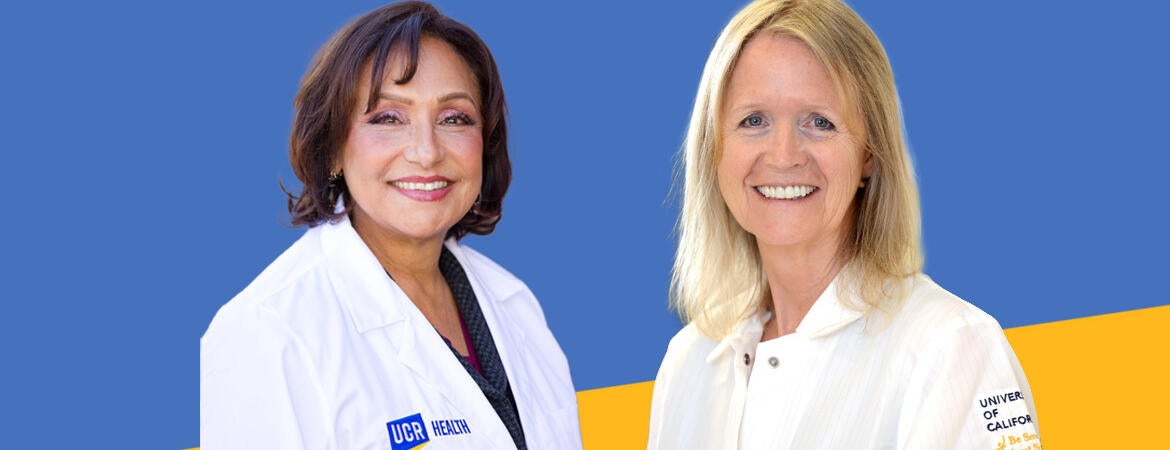
Two UC Riverside School of Medicine breast cancer experts, Ameae M. Walker, PhD, professor of biomedical sciences, and Michelle A. Bholat, MD, chair and clinical professor of family medicine, answer a few questions about breast cancer and the awareness month below.
What is the biggest misconception around breast cancer prevention, diagnosis, or treatment that you'd like to correct?
Walker: That it is a disease of older women with big breasts. Men and young women and those with small, dense breasts can get breast cancer and, unfortunately, they often have a more aggressive form of the disease. It is important for everyone to be aware of possible symptoms.
Bholat: “I don’t have a family history of breast cancer, and my last mammogram was normal, so I don’t need to worry.” That is a misconception I would like to correct. More than 85% of women diagnosed with breast cancer have no family history of the disease. Mammography remains essential, but a normal result does not eliminate risk. Dense breast tissue can both increase breast cancer risk and make tumors harder to detect on a mammogram.
As physicians and health systems, we must move beyond a checklist confirming that a mammogram was completed. We should help every woman understand her individual risk through a careful assessment of her personal history, prior breast biopsy findings, chest radiation at a young age, and family history on both sides. Inherited risk can come from a father’s family as well as a mother’s.
These conversations also create opportunities to discuss reducing risk through limiting alcohol, staying physically active, and maintaining a healthy weight, particularly after menopause. Women should understand their imaging results, including breast density, and report new breast changes even after a normal mammogram. Risk assessment tools, such as Tyrer-Cuzick, depend on accurate, complete information. Together with clinical judgment, these estimates can guide decisions about additional screening, genetic counseling, and prevention. Our goal should be an individualized plan that each woman understands and can follow.
What main advice would you share about lowering breast cancer risk or improving outcomes for individuals?
Walker: 1) Exercise and generally staying active, which, in addition to directly lowering your cancer risk, will also likely lower risk by reducing excess fat.
2) After removal of lymph nodes, the very best exercise to re-establish lymphatic drainage (once thought not to occur) is swimming. The pressure from surrounding water helps to prevent swelling while new lymph vessels are formed in response to the exercise.
What research are you doing, or have you done, on breast cancer? What were your findings and how did they contribute to the field?
Walker: Epidemiologically, one can show that levels of the hormone prolactin (present in both men and women) in the upper quadrant of what is clinically considered normal are associated with an increased risk of breast cancer. Work from my lab has determined that a specific form of the prolactin receptor, a molecule on cell surfaces that recognize the presence of prolactin, promotes breast cancer and breast cancer metastasis by effects on the breast cancer cells themselves, the tumor stem cells, and immune cells in the tumor microenvironment. More importantly, we developed a drug candidate that specifically eliminates this receptor and results in tumor cell death and the inhibition of metastasis in various mouse models of the disease. Attacking the receptor is important because lots of cells make prolactin and there is no drug that inhibits prolactin production by all cells. In addition, our drug leaves intact other receptors for prolactin that inhibit cancer cell growth and so is far more specific than agents like antibodies to the receptor.
What recent breast cancer research or treatment breakthroughs excite you the most and why?
Walker: 1) Analyses of the safety and efficacy of less aggressive approaches to treatment so that the diagnosis is not so devastating, especially to younger women.
2) The search for more specific adjuvant therapies that are both more effective and do not cause osteoporosis or cognitive issues. Let me explain: Loading on another drug with all of its own side effects to combat osteoporosis caused by the most frequent breast cancer adjuvant therapy used today just is not the best approach! Also, in regard to effects on the brain, when I was diagnosed with breast cancer in 2001 and prescribed post-surgical adjuvant therapy, the idea that it had adverse effects on the brain was pooh-poohed, even by breast cancer researchers at national conferences! Brain impact is now an area of research--so I think we are doing a better job of listening to patients about their experiences.
Bholat: I am particularly excited by opportunities to bring breast cancer research into communities with limited access to specialty care. On October 23, 2026, the City of Hope-UC Riverside Biomedical Research Initiative (CUBRI) shared an opportunity to collaborate with a City of Hope breast surgical oncologist interested in strengthening breast cancer research, care, and education in resource-limited communities, including those in the Inland Empire.
For me, the promise lies in connecting scientific discovery with everyday clinical practice. Translational research helps move discoveries into care, while implementation research examines how to make effective care accessible and sustainable in real-world settings.
This opportunity brings those priorities together. It could help us address persistent misconceptions, strengthen individualized risk assessment, and reduce barriers to timely diagnosis and treatment. As a family physician, I am excited by the prospect of connecting primary care, specialty expertise, and community partnerships so that advances in breast cancer care reach the women who need them.
Why is Breast Cancer Awareness Month meaningful?
Walker: It reminds us just how prevalent the disease is. I was totally unaware of the prevalence growing up because no one ever talked about cancer--for some reason it was shameful to have cancer! Hopefully, no remnant of that era exists today. A worrisome trend is an increased incidence in younger women, in whom screening is not routine unless there is a family history of breast cancer. Breast Cancer Awareness Month helps to increase screening.