During a routine doctor’s appointment, Kay Monteith was chatting with her physician about her job. Monteith, who had recently joined the UC Riverside School of Medicine’s Office of Faculty Development at the time, described her new role as an instructional designer. “I said I take the doctors’ PowerPoints and make them a little bit easier to learn or enjoyable to look at,” Monteith recalled.
Her physician’s reply was simple yet heartfelt: “Thank you.”
The physician’s gratitude reflected years of experience in a field characterized by complex lectures and dense presentations. These difficulties influence perceptions about the Office of Faculty Development. “One of the challenges of faculty development is that sometimes it's seen as the place where bad faculty go to get fixed,” explained Rosemary Tyrrell, EdD, the office’s director.
But Tyrrell, a career educator and 10-year SOM faculty member, said this isn’t the case. “It’s all about trying to support and encourage a culture of excellence in teaching,” she said. “We try really hard to shift that to a place where excellent teachers come to enhance their craft, not a place for bad teachers to get sent as some kind of punishment.”
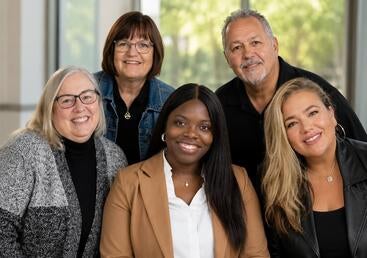
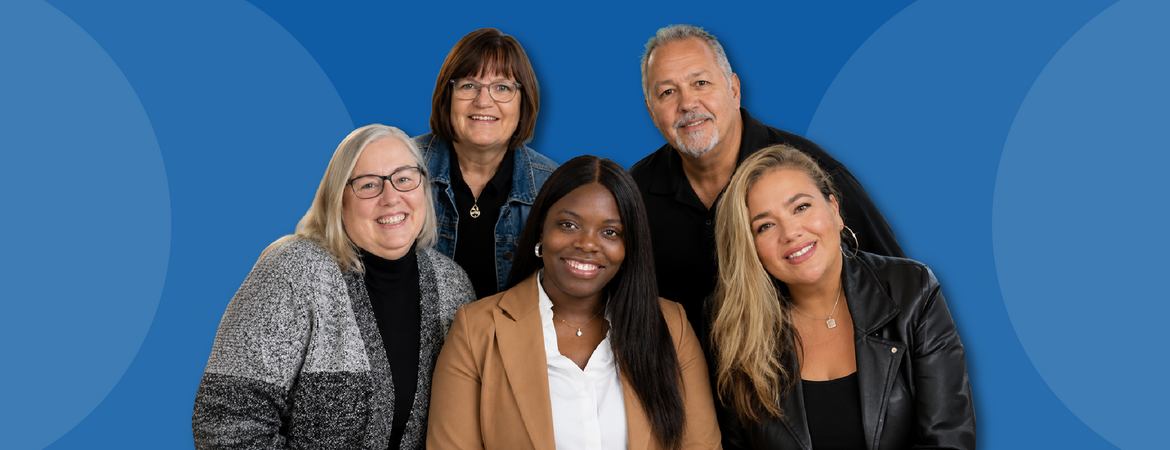
Rosemary Tyrrell, EdD, Nnennaya Akabogu, and Lisa Amaro
Some faculty have taken this message to heart, setting an example for others. Associate Dean for Biomedical Research Meera G. Nair, PhD, spoke about embracing imperfection at the SOM’s recent Women in Medicine and Science event in September. “It's given me confidence to ask, for example, Dr. Tyrrell to come and sit as one of the students in one of my active learning sessions,” Nair told the audience. “She gave me some great feedback on what I needed to improve upon, and I think we should all think that we can make mistakes and we can improve upon them; it doesn't mean that we're not good.”
Tyrrell also created the Teaching Excellence Academy (TEA), the office’s flagship program, to promote positive messaging. The academy provides one-on-one consultations, teaching observations, and more for faculty nominated and accepted into the program. “These are people who are very committed to improving their teaching,” Tyrrell said. “It's great to work with people who are really excited about that.”
The program represents only one of the office’s services, many of which go unseen. “I was in a meeting where someone was saying, ‘Your workshops are great, but what I really need is somebody to sit down with me one on one and work on my learning objectives,’” Tyrrell recalled. “I thought, ‘We do that all the time; why is it that they don't know this?’” In response, the office drew on its own media services to create short videos highlighting its other offerings.
“I think sometimes people don't see everything that we're doing because a lot of this is happening in ways that they might not recognize,” Tyrrell said. “But I think it really does enhance the School of Medicine to have these services available.”
Instructional design
Tyrrell highlighted instructional design as one offering that faculty and staff may overlook.
A large part of the service involves Monteith’s work to enhance faculty members’ slide decks. She modifies existing slides to enhance clarity and conciseness, and even creates new presentations out of plain text. “People like to put everything that students need to know on the slide, and getting them to put just bullet points, making it less dense and more eye appealing for less cognitive overload, that's probably the biggest victory,” Monteith said.
She works on presentations both for established and new courses. “Typically faculty who are coming in for the first time reach out to me to get some direction on what block directors and students are looking for,” Monteith said. She added that she can also assist faculty whose student evaluations called out overly dense slides.
Some faculty are concerned that the process may be time consuming or may significantly alter their original materials. Neither is the case. Monteith works on the slides on her own, creating a new set for the faculty member to compare to their original presentation.
“People are spending hours and hours developing things that we could be helping them with and lightening their load,” Tyrrell said. She has used Monteith’s instructional design expertise herself. “Sometimes when I'm busy, I just put words on a white background and Kay makes them look amazing and polished and professional.”
Monteith’s role also includes preparing sites on Canvas, the university’s learning management system, for each course every school year. “I sit down with a lot of people and work with them one on one on how to upload things into Canvas and how to set up the Canvas course site,” she said. “I enjoy that part of getting to know some of the faculty.”
With a background in elementary school education and a certificate in instructional design from UC Irvine Extension, Monteith’s overall goal is to create pedagogically sound instructional materials. As part of this effort, she hopes to transform more independent learning courses into interactive modules. “Instead of students just flipping through slides, I used software to create a professional experience with built-in quizzes and activities, and the students really seemed to like it,” she said of one module. As with her other work, Monteith said creating modules doesn’t require a significant time commitment for faculty. She just needs their input as subject matter experts. “Then I create it, I send it to them for their feedback, and if they have any changes I make them, and it's ready to go,” she said, encouraging faculty to take advantage of the offering.
Videos and technology
Creating interactive modules is often a team effort alongside Guy Stoil, the office's instructional technologist and video production specialist. Operating out of a full video studio in the SOM Ed II building, Stoil produces educational videos, promotional clips, tech explainers, and more.
Stoil works directly with faculty members on educational presentations and videos, such as recording one faculty member’s voice and pairing it with slides to create a virtual presentation video. For his promotional videos, Stoil recently highlighted the SOM’s new EVOLVE curriculum and the educational modules within it. He also has a video series called Tech in a Sec with short videos explaining quick technology lessons, like how to make graded quizzes on the Poll Everywhere platform for faculty or how to unclutter a computer desktop. “I've always loved technology and I've always been fascinated by the use of technology in instructional design to make it easier for learners to grasp concepts,” Stoil said.
He brings storytelling concepts to each project from a decades-long career in the TV industry. That period included a nine-year stint on Grey’s Anatomy, an experience Stoil called “ironic” now that he works in medical education.
“I think knowing how to tell a story visually is a big asset to instructional videos,” explained Stoil, who taught high school video production courses and earned a graduate degree in instructional design after leaving Hollywood. “If you can tell the story effectively and use good pedagogical techniques throughout the video, you can make a greater impact with the learner.”
As an instructional technologist, the second half of Stoil’s role, he evaluates potential new software and devices for faculty. “I make sure that what they're asking for will do what they're asking, make sure it's pedagogically sound, and then I provide them with my consultation report, telling them I think this is a great tool or maybe giving them alternatives,” he said.
He also provides consultations on learning to use programs, from Poll Everywhere to Google Video. “A lot of the faculty are super busy, they're clinicians, they're teaching, and they don't have time to sit around for an hour or two to figure out how a piece of software works,” he said.
Acknowledging that technology can be intimidating, Stoil said he’s patient when explaining its intricacies. “I always tell people, ‘Don't feel bad because you have to ask… that's why I'm here,’” he said. “I do think that it has the ability to make your job really easy if you just let it work for you.”
Reaching faculty
The Office of Faculty Development staff, which also includes program coordinator Nnennaya Akabogu and administrative assistant Lisa Amaro, encouraged faculty of all levels to take advantage of their services. “I would recommend anyone who is new to teaching to come in… because if you can get them in the door while they're still learning to be educators, we'll see the results over time,” Tyrrell said. She added that they can help mid-career faculty as well. “We could actually make your life easier, is a message that we don't often say enough,” said Tyrrell.
Stoil urged staff working on department projects to visit, too. “Anyone that wants to make things easier and better should come,” he said.
Tyrrell acknowledged that the office cannot reach all faculty at the SOM through scheduled programs, with more than 1,400 community faculty unavailable during daily clinical hours while other faculty are only on campus during the workday.
Still, Tyrrell has seen the office’s impact among faculty members. “A few times people have said, ‘I changed everything I do based on what I learned in the Teaching Excellence Academy,’” she said. “Or somebody will say in a meeting, ‘Dr. Tyrrell will yell at me if I don't change this word ‘understand’ because it’s not a measurable learning objective,’” she added. “The message is getting through and that’s great to see.”
Serving students and the mission
By successfully helping faculty, the Office of Faculty Development serves students and the SOM’s mission. “Ultimately it's about the students–we want excellent teaching so that the students will get a better education, and that supports our mission because better doctors out in the community is what we all want,” Tyrrell explained.
“I think technology, if used correctly, can make education fascinating, more accessible, interesting, and students who are interested and fascinated by things are engaged,” Stoil added. “Keeping students engaged can lead to greater learning outcomes, and that falls in line with the mission of the School of Medicine of contributing to public health in our inland community.”