On Monday, the UCR School of Medicine hosted the 2026 Celebration of Women in Medicine and Science to recognize and honor women's advancements in the field of medicine. Presented by the Office of Faculty Development and the Office of Strategic Initiatives, the annual event featured a keynote address by Alison Whelan, MD, chief academic officer of the Association of American Medical Colleges.
UCR Provost and Executive Vice Chancellor Elizabeth Watkins, PhD, joined the celebration to deliver opening remarks, helping set the tone for this year’s theme of “Centering, Elevating, and Sustaining Women’s Voices.” Her participation underscored the university’s commitment to recognizing the achievements and contributions of women in medicine and science and highlighted the importance of creating opportunities for women’s voices to be heard, valued, and celebrated.
Deborah Deas, MD, MPH, the vice chancellor for health sciences and the Mark and Pam Rubin dean of the School of Medicine, also referenced the theme in her welcome remarks. “Representation matters, but representation alone is not enough,” Deas said. “One of the most powerful things we can do for one another is create spaces where people can speak openly about their experiences, the opportunities they have encountered, the barriers they have navigated, the lessons they have learned, and what they believe needs to change,” she continued. “That is what today is about.”
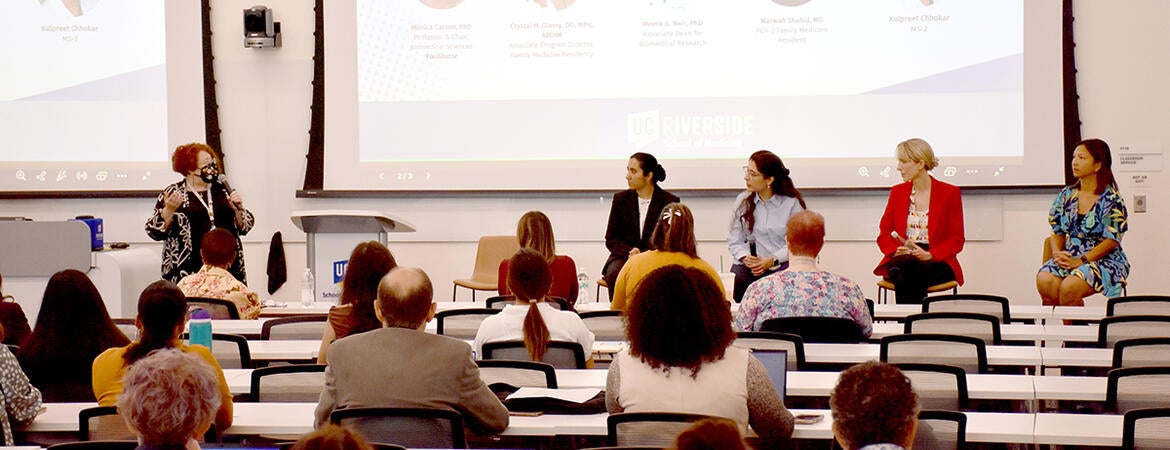
In line with this goal, the event began with a panel discussion that created an opportunity for women in a variety of roles and career stages to share their perspectives. Moderated by Monica Carson, PhD, chair of the Division of Biomedical Sciences, the panel included Crystal M. Glassy, DO, associate program director of the family medicine residency; Meera G. Nair, PhD, associate dean for biomedical research; Marwah Shahid, MD, a family medicine resident; and Kulpreet Chhokar, a second-year medical student. (Pictured in the banner image.)
From reflecting on the meaning of amplifying women’s voices and how to achieve such amplification to discussing ways to find support, the panelists related their experiences and emphasized the importance of networks and mentorship.
For Shahid, providing a supportive culture is crucial. “Amplifying doesn't really just mean being confident and speaking up loud; it also means we have to sometimes read the room, that we're not being judged,” she said. “Being a good mentor is giving you the opportunity to take initiative and giving you the confidence or the courage that you need to speak up,” she added.
Glassy pointed out that women may need different mentors and support groups in different areas and stages of their careers--and that it’s OK that some of them will likely be men. Pointing out that there are fewer women in leadership than she might expect, “If I'm trying to navigate something with respect to leadership, then I might lean into someone else who has that same type of experience,” Glassy explained.
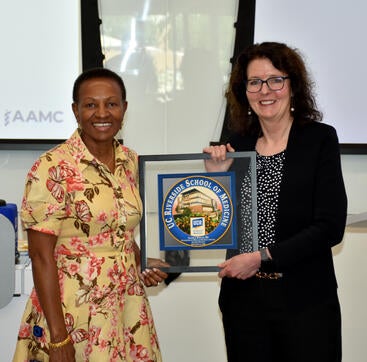
In her keynote address, Whelan shared several stories of male colleagues: both those who negatively affected her confidence, and other men who stepped up to actively support her and her career. She remembered one experience from the end of her medical student internship when her male attending wrote in her evaluation that she likely wouldn’t do well in a competitive academic medicine program. The comment reinforced her impostor syndrome and nearly prevented her from applying to her residency program.
When Whelan later mentioned her persisting low self-esteem to an older male pediatrician while working in his lab, he immediately called her into his office. “He sat me down and he looked at me… and he was like, ‘Don't do that. You need to believe in yourself,’” she said, adding that he continued to act as a cheerleader during her career. “I've had more men sponsors and mentors than women, probably because there was a greater percentage of them, and we really need to applaud and thank them for the support that they give us as well,” she said.
“Success… is not just representation, it's not just having women in the space, but actually truly having their voice, having leadership roles, and thriving, and feeling like they belong,” Whelan added. She displayed data showing progress on areas including women’s representation in medicine and issues like pay equity, but emphasized that significant gaps remain. While 52% of medical school graduates are now women, for instance, women represent only 48% of residents and only 33% of deans.
Similarly, Whelan noted that although pay for clinical science roles rose from 76 cents to 79 cents between 2019 and 2026 for women compared to one dollar for men, it remains significantly below men’s wages. For change to occur, she stressed, “It takes dedicated commitment from lots of people.”
Whelan concluded by highlighting strategies for women to use to help advocate for themselves, including documenting accomplishments and sharing positive feedback with their manager, drafting their own recommendation letters, and seeking positive mentors.
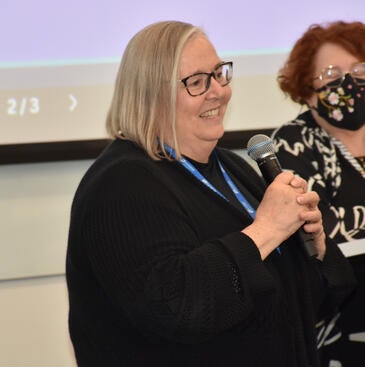
This year’s event “challenged us to think about whether women's perspectives are not only being heard but are genuinely influencing decisions, shaping our institutions, and advancing our professions,” said Rosemary Tyrrell, EdD, director of the Office of Faculty Development. In addition to organizing the event, her office produced eight videos highlighting the work and experiences of women at the SOM as part of the broader observation of the American Medical Association's Women in Medicine Month. “We wanted to recognize these women and share their stories with the wider community, not just those who could attend the event,” Tyrrell said.
In the spirit of the celebration, Deas acknowledged Anita Gupta, DO, a community faculty member at the SOM, for recently receiving the Distinguished Women in Medicine Award from the California Legislature. Gupta additionally received a proclamation designating February 3, 2027, as Women in Medicine Day in San Diego. “These recognitions are a wonderful reflection of the leadership, achievement, and commitment to advancing women in medicine that we hope to celebrate through this event,” Deas said.