When Jorge Delos Santos, MPH, first entered the new Master of Public Health (MPH) program at the UC Riverside School of Medicine, he was focused on community health and worked at Riverside-based nonprofit TruEvolution. Over the course of the two-year program, though, Delos Santos developed a new goal: working in public health at the government level.
Now the 2026 graduate is starting a new role at the San Bernardino Public Health Department, where he’ll work to manage infectious diseases in the local region.
Delos Santos was part of the first 12-student cohort in an MPH program whose graduates are already making an impact in the area. “It was a great group of students who all really had a commitment to serving underserved communities, whether in the Inland Empire or beyond,” said Mark Wolfson, PhD, chair of the Department of Social Medicine, Population, and Public Health (SMPPH) at the SOM who helped develop the program.
A program for the community
UCR’s program is unique as one of the only MPH degrees in the region offered by a public university. “It's a special program because there aren't that many programs that serve inland Southern California… so we're a small exclusive club,” Wolfson said. “Nationally there are many programs that are really excellent academically, and there are many programs that really shine when it comes to focus on a particular mission… but there really aren't that many programs like ours that do both.”
For students like Delos Santos who worked in the nonprofit sector yet had no public health background, the program covered foundational concepts along with research design. “I was able to learn how to name a lot of the things I was already doing, tighten up my grant writing, and was able to then finally understand what a lot of these contracts were asking for, and… get a better understanding on looking at local demographic data,” Delos Santos said. “Because we had a mix of professors from different professions… their expertise in coming from an actual public health career also strengthened my toolkit.”
He particularly remembered one session with Michelle V. Porche, EdD, director of Clinical Faculty Research Development and Scholarly Activity and Lisa R. Fortuna, MD, MPH, chair and professor of the Department of Psychiatry and Neuroscience, walking the class through the use of logic models. “Books use theory but I wasn't able to connect it, but Dr. Fortuna and Dr. Porche took one class to show us how they implemented their research, their research question, and their program with the logic model,” Delos Santos recalled. “They took us step by step and answered questions, so I feel like that was amazing,” he added. “We did have similar things in different classes where professors would bring in their own research, and that was my favorite part because I finally understood what a lot of these theories meant and how to implement them.”
Besides the program’s multidisciplinary instructors, who represent 12 departments across five colleges at UCR, MPH students appreciated the program’s cohort model. “I love the size of this program and the fact that it's a cohort, and I feel very fortunate to have worked with everybody who's been involved,” said Nina Ruedas, LMFT, MPH, a member of the inaugural MPH class of 2026.
“You have an opportunity to be in an intimate class setting, which I think strengthens the bond for our students with one another, so that's an advantage,” added Mario Sims, PhD, faculty director of the MPH program. “You get intimate classes with a small class size, so you have a chance to really take a deep dive into public health issues, whether it be policy, ethics, epidemiology, or methods.”
Another notable aspect of the program was the final capstone or thesis project designed to positively impact the community. The project required each student to partner with a community organization and create a program or study that would benefit them. “We as a program are very proud that these projects were not just an academic exercise, but actually will be useful to the agencies that the students partnered with,” Wolfson said.
Ruedas’ capstone focused on women’s health. Working as the director of the Women’s Resource Center at UCR since 2023, she entered the MPH program with a love of public health and enthusiasm to be part of something new. Her capstone involved taking 14 UCR undergraduate students to Palm Springs to learn about women’s health through working with local community organizations. The experience benefited not only the students, but Ruedas’ own understanding of how to increase student access to women’s services.
Ruedas said she appreciated the MPH program’s community-centered approach and its focus on critical health literacy, which she used in her capstone. “It's not focused on individuals modifying their behaviors, but it's more about the socio-cultural context, what we can do to promote health equity, and what changes we can make to inspire systemic change,” Ruedas explained. “It was a lot of fun because I hadn't learned about that before, and I think I was craving something like that.”
Throughout the program, Delos Santos and Ruedas appreciated the support from faculty and staff, particularly Cristina Gonzalez, a project manager in SMPPH. Gonzalez herself holds a Master of Health Leadership and was able to draw on her background to help guide the MPH students. “Having the graduate training, combined with working in a hospital for many years and in the research department, gave me the skills and experiences that I could share with the students,” Gonzalez said.
“I was always surprised how caring, supportive, and available Cristina was. Every time I reached out to her, she always responded, and if she was not available, she would always call me back,” Ruedas recalled. “And because it's a smaller program, we got more attention and care than if we were at a really large program where we might get lost, so I think the compassion and the care that we received is just amazing.”
First cohort: Complete
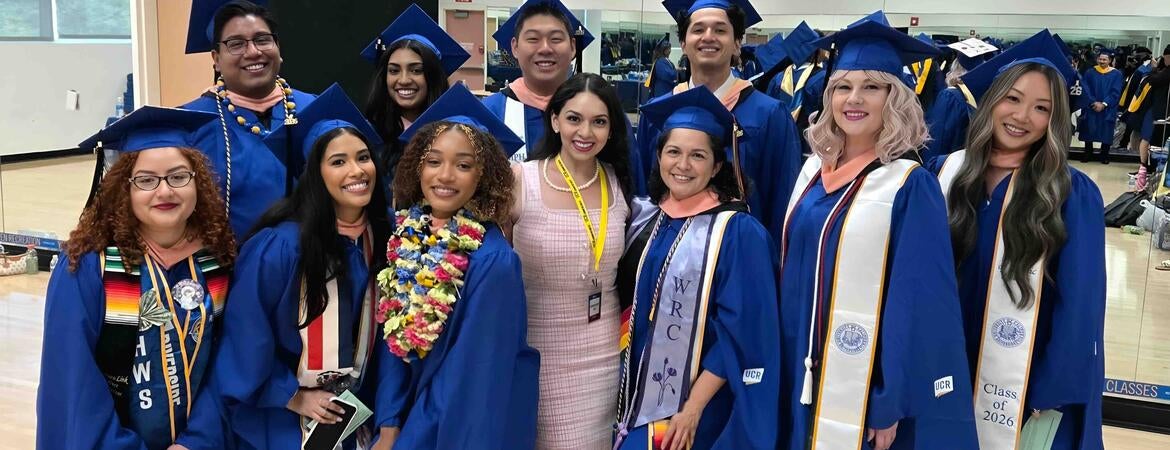
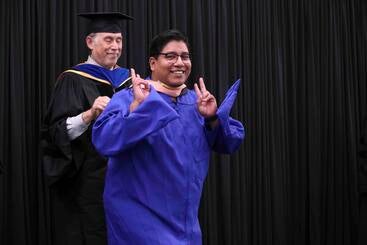
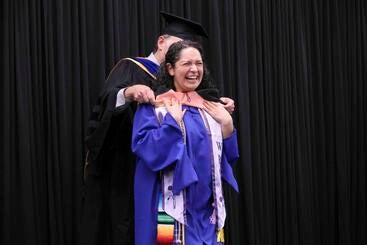
After two years, everything came together for the program’s first commencement ceremony in June 2026. “Seeing the students at the hooding ceremony, watching them walk across the stage, and witnessing the smiles on their faces after all they had accomplished was truly beautiful,” Gonzalez said.
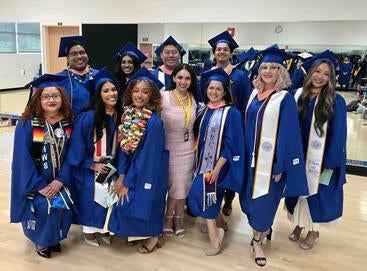
“It was a culmination of everything—all the hard work that our staff has accomplished over the years,” Sims added. “Seeing the growth in the students in their orientation to public health, how they thought about it, and the tools they learned to analyze problems in the community and to develop and think about strategies to bring about health equity in an unequal society… to see their growth and development in those areas from start to finish was really a pleasure.”
Marshare Penny, DrPH, an epidemiologist and associate adjunct professor in SMPPH, noted the particular strength of the first cohort. “The level of writing skill that I found in reviewing papers and submissions, I really was impressed with the capacity of the students and the talent there,” she said, predicting that some will go on to start their own foundations and nonprofit organizations.
With her new degree in hand, Ruedas plans to pursue a PhD in Education, Society, and Culture at the UCR School of Education with a focus on sexual health education in higher education. “The MPH was an amazing and essential step and helped prepare me for this next program, so I'm really excited… I feel like I can definitely expand my knowledge and awareness of sex ed, especially on college campuses,” she said.
Ruedas said she’ll also be able to share her experience with UCR students considering the degree, as well as serve students better overall. “Even with my lived and professional experiences, doing two years of this program has prepared me to continue the work and do it with more intention, knowing that it's data driven and grounded in theory, and that feels amazing,” she said.
Delos Santos said he hopes UCR starts a public health PhD program so he can return for his doctorate, citing his appreciation of the school’s focus on diversity and serving his home community. “Even after all the changes that are going around in academia right now, UCR is still committed to diversity and inclusion, especially at the medical school level and over on campus, and that really falls with my beliefs,” he said. “That's why I would always go back.”
Preparing for the future
The MPH program continues to make enhancements based on experience and student feedback, but already serves as a notable local offering. The number of applications in the first years have shown the substantial interest, and the high need, for the program in the community. “They had a great turnout of students that were interested, and that just lends itself to the fact that a public program was needed in the area,” said Penny.
With its holistic admissions process, Wolfson reminded potential applicants that work and life experience matter in addition to academic achievements. “We look for students with great academic ability, but we also look for students who have a commitment to public health, and specifically this idea of serving underserved communities and promoting health equity,” Wolfson said.
“We’re helping shape the next generation of public health leaders, although many of our students are already making a difference in the field,” Gonzalez added. “Public health has such a broad reach across individuals and communities, so I would encourage anyone who wants to improve health, enhance quality of life, and create meaningful change to apply.”
While the degree may benefit pre-med students, it has the potential for a much broader impact. In fact, Gonzalez pointed out that some students entered the program with the goal of becoming a physician only to realize they could influence community health in a variety of other ways. “Our program has changed how students think about the difference they can make,” she said. “There is no single path in public health; the field offers many opportunities for people to contribute in ways that align with how they want to make an impact.”