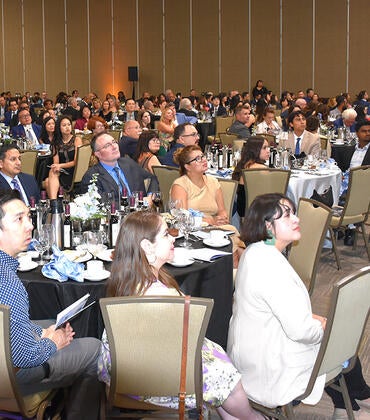
In the aftermath of the COVID-19 pandemic, researchers shifted their focus towards preventing the next possible pandemic by developing the next generation of vaccines to provide protection against a broad base of coronaviruses. On Thursday, Oct. 22, 2026, Pamela Bjorkman, PhD, of the California Institute of Technology shared some of the recent breakthroughs in vaccine development at the Thomas and Salma Haider Biomedical Breakthrough Lecture at the UC Riverside School of Medicine.
The annual lecture series has brought the best and brightest biomedical scientists to the UCR SOM. The lecture, now in its eighth year, is supported through the generosity of an endowed gift from Thomas Haider, MD, and Salma Haider, longtime supporters of medical education and research at UCR.
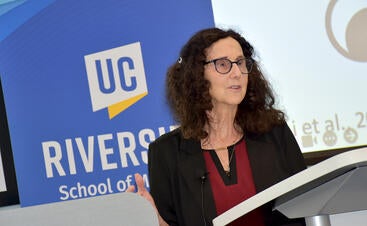
Bjorkman, the David Baltimore professor of biology and biological engineering and a Merkin Institute professor at Caltech, outlined the strategic approaches being taken to develop a universal coronavirus vaccine that recognizes and targets features shared across all SARS-type coronaviruses, rather than specific viral strains.
Bjorkman explained that coronaviruses, specifically sarbecoviruses like SARS-CoV-1 and SARS-CoV-2, often jump from animals into human populations, and that minor spillovers in rural populations with high wildlife exposure occur more often than most people realize. This demonstrates the urgency to create proactive booster shots that provide broad protection against both existing variants as well as strains that have not yet been identified.
“There have been two of these events that were caused by spillover from bats in the last 20 or so years,” Bjorkman said. “The first was the original SARS in 2002 and the next one was SARS-CoV-2, which caused the COVID-19 pandemic starting in 2019.”
“Because we know it keeps happening, we need to prepare for the next sarbecovirus spillover that can be transmitted between humans,” she said.
Bjorkman is among the leading researchers who are working on a vaccine strategy that targets the base of the virus, rather than the tip. Coronaviruses use a component called the Receptor Binding Domain (RBDs) on the tip of the spike protein to bind to human cell receptors. These tips can mutate rapidly, allowing new variants to emerge that escape old antibodies. In contrast, the base and sides of RBDs, called “conserved” areas, do not mutate and are largely the same across different viruses.
To direct immune cells toward these shared structural features, researchers have created a “mosaic” vaccine, Mosaic-8b, which targets RBDs from eight different coronavirus strains. In trials with mice and non-human primates, the Mosaic 8b vaccine protected against both coronavirus strains represented in the particle as well as other strains.
One of the challenges facing researchers looking to deploy this in humans is overcoming immunological imprinting, also known as Original Antigenic Sin (OAS), originally named in the 1950s by virologist Thomas Francis, Jr. OAS takes place when the human immune system that has been previously exposed to coronavirus through vaccines or infections defaults to recycling old antibodies rather than producing new ones. Researchers demonstrated that Mosaic-8b both recalls and boosts existing antibodies and stimulates the creation of new antibodies specifically targeted at the new regions.
Another innovation has been the development of Single-Shot Pulsatile Release, which allows for vaccine particles to be released in a controlled fashion over a predetermined period of time using Atomic Layer Deposition (ALD). This release is a significant improvement over standard single-dose injections.
“You don’t have to have a prime and boost, or a prime and two, or three, or four boosts. You can do it all with a single injection,” Bjorkman said.
The challenge is that it is extremely difficult to mass produce these complicated components. This has led investigators to attempt to adapt the design into an mRNA format. This design elicited antibody responses that were superior to the original protein nanoparticles while stimulating T-cell responses, moving closer to a broad-spectrum, universal COVID-19 booster that can protect against future sarbecovirus spillovers.