Step into a research lab at the UC Riverside School of Medicine, and it’s common to find faculty members, graduate students, and medical students working together to improve patient care and strengthen the health of communities in the Inland Empire and beyond.
But they’re not the only ones making an impact.
Undergraduate students play an active role in research across the SOM, gaining firsthand technical experience, developing problem-solving skills, and exploring future careers as they work alongside experienced research mentors in both the lab and the community.
For some of these undergraduates, the journey into research began with nothing more than a single email.
Mentorship driving student success
Undergraduate students often become involved in SOM research through reaching out directly to advisors whose work aligns with their interests, whether that work is independent or through different research programs such as the honors program.
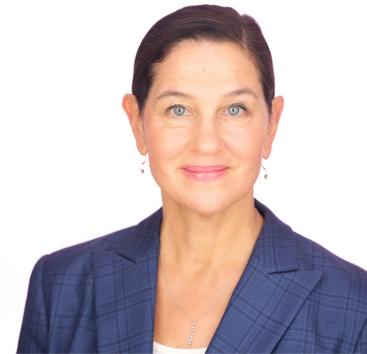
One advisor who frequently works with undergraduates is Elizabeth A. Jacobs, MD, MPP, a clinical professor of internal medicine. For Jacobs, mentoring undergraduate researchers is an important part of her work. By providing students with opportunities to participate in research, she helps them build skills, explore career paths, and gain experience.
“Our mission at the School of Medicine is to help bring in the next generation of health professionals,” Jacobs said. “I really see mentoring undergraduates as part of that process.”
By providing students with these opportunities to participate in research, Jacobs helps them build skills, explore career paths, and gain experience. Her research, in particular, focuses on health equity and community-engaged approaches to improving health outcomes. She encourages students to pursue questions that genuinely interest them while gaining firsthand experience with the realities of research.
“I really try to work with what inspires students,” she said. “If you’re passionate about it, you’re going to work hard at it, enjoy it, and put your effort into it.”
Through mentoring, Jacobs seeks to expose students to every stage of the research process, from developing a research question and designing a study to collecting data, analyzing results, and preparing findings for publication. She also emphasizes that research often requires flexibility and persistence.
“Research never goes as planned,” she said. “Students learn resiliency, problem-solving, and how to adapt when the original path doesn’t work.”
For students who may feel intimidated or underqualified to pursue research opportunities, Jacobs offers reassurance. “Everyone starts not knowing what they’re doing,” she said. “That’s why we mentor people. We’re excited that students want to learn.”
Among the most rewarding aspects of mentoring, she added, is watching students achieve their goals and eventually support future generations of researchers themselves. “Don’t be afraid to ask,” Jacobs said. “You’ll find the right person.”
Investigating viral mechanisms through structural biology
Nabeeha Shaukat, an incoming third-year cell, molecular, and developmental biology major, is an undergraduate researcher in the laboratory of Associate Dean of Pre-Clerkship Medical Education, Scott Pegan, PhD. The experience has provided her with early exposure to virology and structural biology through the study of Crimean-Congo Hemorrhagic Fever (CCHF), a severe tick-borne virus with limited treatment options.
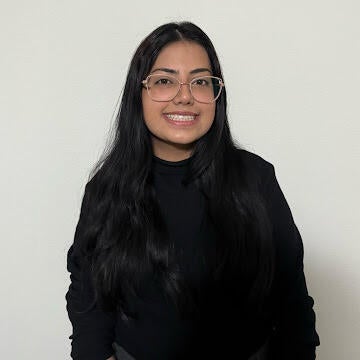
Interested in research long before starting her undergraduate studies, Shaukat said she chose UCR in part because of the ample opportunities available for student research. Once on campus, she began looking into different labs and learned about the work being done in Pegan’s lab, prompting her to reach out. Her cold email and participation in the UC Leadership Excellence through Advanced Degrees (UC LEADS) program eventually led to a position in the lab, with her work focusing on a key immunological question around why CCHF antibodies that bind to the same region of the virus can produce different levels of protection.
“We have all of these antibodies binding to the same site,” she explained, “but they don’t all confer the same level of protection.”
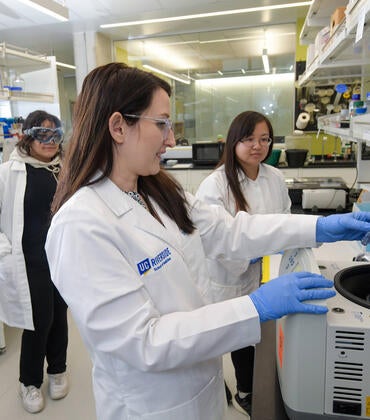
To investigate this question, she contributes to protein purification workflows, cell culture maintenance, and experimental preparation. Beyond developing technical skills, Shaukat said research reshaped the way she approaches scientific questions.
“It made me more willing to keep up with current literature,” she said, noting that the experience strengthened both her interest in internal medicine and her desire to remain involved in biomedical research throughout her career.
Turning health disparities into research questions
Not all undergraduate research takes place at the laboratory bench. Roles and responsibilities greatly differ between labs and research mentors, with some undergraduates providing support for the graduate students while others play a larger role in developing and executing projects.
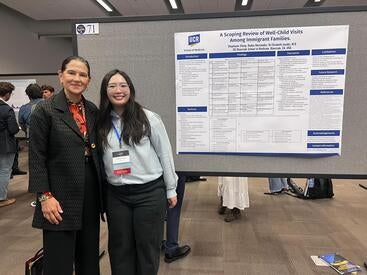
For Stephanie Zheng, a recent class of 2026 graduate and former UCR Honors Program member, undergraduate research was always something she expected to do. Within the UCR honors program, students are required to complete an honors capstone project spanning multiple years, consisting of some sort of undergraduate research. In her search for an advisor for her capstone project, Zheng reached out to Jacobs.
Conducted under the mentorship of Jacobs and research coordinator Nadya Hernandez, Zheng’s project used a scoping review methodology to explore how structural, linguistic, and cultural barriers contribute to disparities in pediatric healthcare access in underserved communities, including the immigrant families in the Inland Empire. Her research involved examining barriers to access to well-child healthcare among immigrant families.
The project initially began as a qualitative study involving interviews with parents in a pediatric clinic. However, recruitment challenges and time constraints ultimately required the team to adapt their approach and transition to a scoping review.
Rather than viewing the change as a setback, Zheng described the experience as one of the most valuable aspects of the project. “It taught me professionalism, time management, and how research actually gets written and structured,” she said. “Presenting at the symposium was really memorable because it was my first time sharing my work in that setting.”
Through the project, Zheng gained a deeper understanding of healthcare disparities and strengthened her commitment to pursuing a career in medicine focused on serving underserved communities.
Learning medicine through research training and clinical exposure
Bryan Torres, a rising third-year medical student at UCR, gained a glimpse into how scientific discovery translates into patient care through undergraduate research. The experience helped inspire him to pursue medicine.
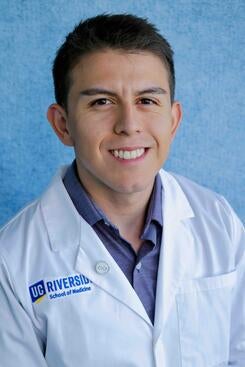
Initially uncertain about his career direction, Torres transitioned from an interest in law enforcement to biomedical science during his undergraduate studies at UCR. After his early undergraduate career was disrupted by the 2020 COVID-19 pandemic, Torres wanted to get more involved once he returned to campus and ultimately decided to participate in undergraduate research. Torres reached out directly to faculty members whose projects interested him, then joined Pegan’s laboratory and began working alongside graduate students and postdoctoral researchers.
“Undergraduate research gave me the opportunity to see how research is actually conducted,” he said. “Working alongside graduate students and postdoctoral researchers taught me how scientific discoveries are made and how they can ultimately improve patient care.”
Although his role focused largely on supporting ongoing research, the experience helped him better understand the connection between laboratory discoveries and medical treatments. “It made me realize how much research actually impacts medical treatments,” he said. “That was something really memorable for me.”
He added that working in a research environment also helped affirm his academic and professional path. Being surrounded by scientific inquiry and biomedical sciences solidified his decision to enroll in medical school, where he continues to build upon his skills, experience, and knowledge. He is now pursuing a medical degree with an interest in emergency medicine.
Building the next generation of researchers and physicians
Although their projects span diverse disciplines, from infectious disease research and health equity to clinical and community-based studies, each student described research as an experience that extended far beyond technical training. Through mentorship, problem-solving, and firsthand exposure to the research process, they gained a deeper understanding of how scientific discovery informs healthcare and improves patient outcomes.
Their experiences reflect the UCR School of Medicine’s commitment to developing future physicians, scientists, and healthcare leaders prepared to serve their communities. Whether working in the laboratory, conducting literature reviews, or exploring questions rooted in community health, undergraduate researchers contribute meaningfully to the SOM’s mission while building skills that will shape their future careers.
For many students, that initial email or conversation becomes the beginning of a transformative academic and professional journey. As Jacobs noted, the first step is often the simplest: “Don’t be afraid to ask."